
HR Tech and AI Work Notes #17
MCPs aren't a silver bullet

Anthropic keeps running up the score. On Tuesday they released Claude Fable 5, the most capable model they have ever made generally available. A few days earlier, their data team published a case study on how they automated 95% of internal self-service analytics queries. To be completely honest, I was personally relieved to see less fuel dumped on MCP “silver bullet” fire, replaced with some tried-and-true basics and practical advice for layering Claude skills on top. Those of you with solid data foundations can start running at this (This was genuinely one of my favorite reads on AI content as far as my memory will serve and I’d like to write a post exclusively about this at some point!).
Also this week, two new workforce surveys that suggest the upskilling conversation is beginning to pick up steam.
Finally, you will notice there is no restructuring/layoff coverage this week. Not to say that layoffs aren’t continuing, but I’m personally tired of covering it. Not to mention we had a great jobs report for May, so let’s collectively pause and take a breath on that content.
If you find value in the rest of this post, consider upgrading to a paid subscription. You’ll be able to engage directly with me and other subscribers for questions/collaboration + access to the full library of articles and tools for $40/year.
🚀 HR Tech Watch
Anthropic released Claude Fable 5
Anthropic launched Claude Fable 5 Tuesday morning, the first publicly available model in its Mythos class. The company says Fable 5’s capabilities exceed any model it has ever made generally available, with state-of-the-art performance across software engineering, knowledge work, vision, and scientific research. The pattern they describe is that the longer and more complex the task, the larger Fable 5’s lead over previous models, and it can work autonomously for longer than any prior Claude release.
The Mythos backstory is what makes this interesting, in my opinion. Anthropic previewed Mythos in April but restricted access to about 150 vetted organizations because the model proved unexpectedly good at finding and exploiting cyber vulnerabilities across every major operating system. Fable 5 is the same tier of technology made safe for general release through a specific mechanism: queries touching high-risk areas like cybersecurity, biology, and chemistry get routed to Claude Opus 4.8, the next most capable model, instead. Anthropic says the safeguards trigger in less than 5% of sessions, and an external bug bounty program with more than 1,000 hours of testing found no universal jailbreak.
The access details are a little wonky though. Fable 5 is included in Pro, Max, Team, and Enterprise plans through June 22. After June 23 it moves to usage credits until capacity expands. API pricing is $10 per million input tokens and $50 per million output tokens, which is less than half what the Mythos Preview cost.
Why you should care:
Anthropic faced a model that was genuinely dangerous in a few specific domains and landed somewhere in between. Most users get full capability. Queries in the risky domains get routed to a model with more conservative limits, and the whole arrangement gets monitored and adjusted as they learn.
I rarely find vendor safety announcements useful as light reading, but this one earns it. If your organization is stuck debating whether to allow AI tools at all, the Fable 5 release gives you a concrete example to put on the table. The most safety-cautious major lab looked at a capability they considered dangerous and chose routing and monitoring over an outright ban. Your internal version might be broad access with tighter controls on specific data and use cases. If your company is an AI laggard debating how to roll out AI functionality, that position is easier to operate than a ban.
Source: Anthropic · CNBC · MacRumors
⚡ Signal From the Field
Anthropic’s data team wrote up how they automated 95% of their analytics queries, and they showed their work
Anthropic published a blog post this week describing how its data science team automated approximately 95% of internal business analytics queries using Claude, freeing the team for the causal modeling and forecasting work that actually requires their expertise.
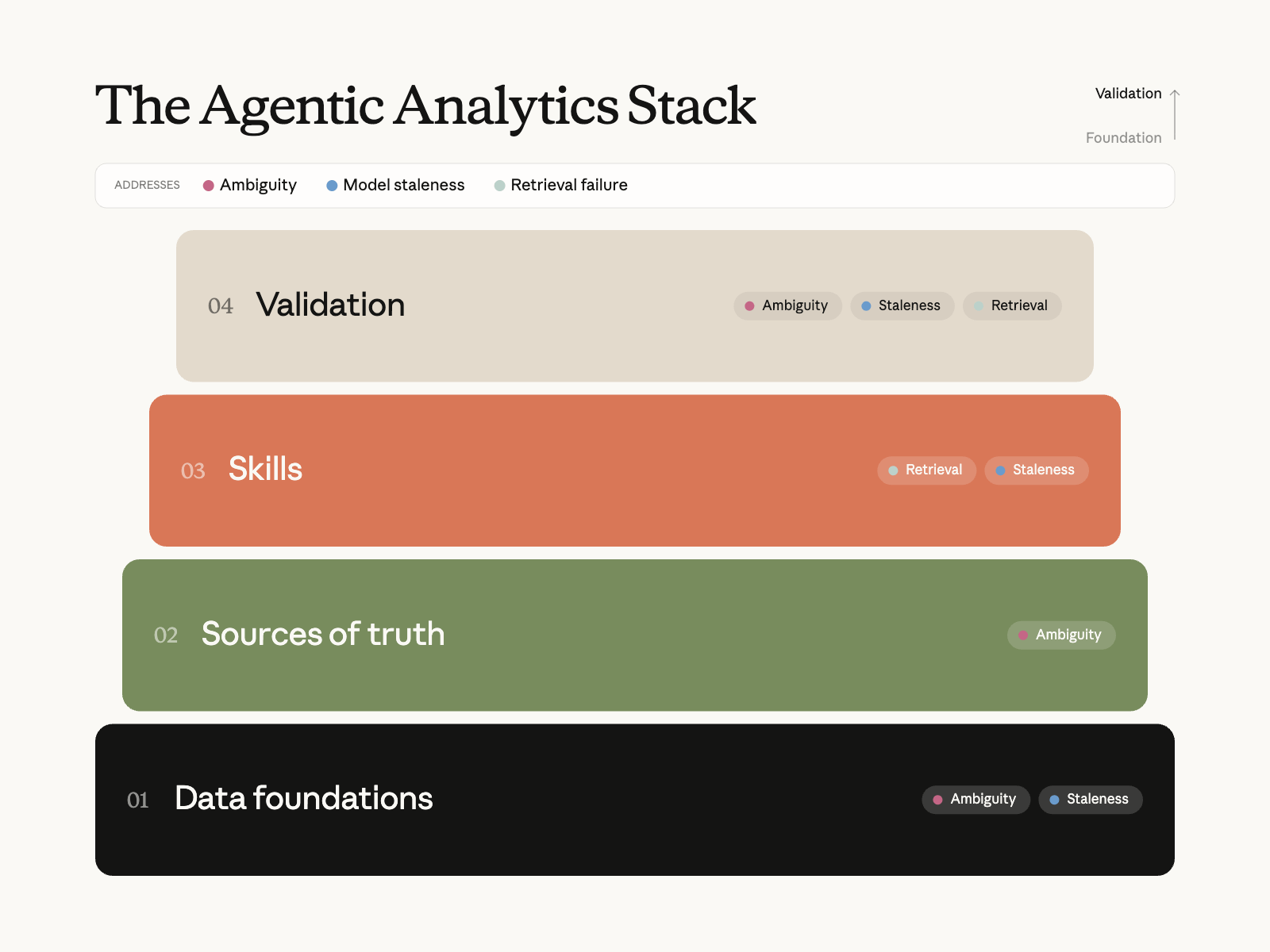
The setup will be familiar to a lot of you who are building an analytics function. The requests feel automatable but automation keeps breaking or requires an infinite amount of reprompts. Anthropic’s diagnosis - the agent writes perfectly good SQL, it just writes it just doesn’t know what to do with it. They identified three failures that account for most inaccurate analytics answers. Concept-to-entity ambiguity, where the agent cannot map a business concept like “active users” to the right tables/ definitions among hundreds of options. Data staleness, where definitions drift and the documentation falls behind without proper governance. Finally, validation gaps, where plausible-looking answers go out the door but lack accuracy.
Their answer is a four-layer stack that isn’t all that revolutionary. Data foundations converge each to authoritative fact tables. Semantic layers establish what metrics mean and the relationship of them. The helpful addition to this stack are how they leveraged Claude skills, which are structured markdown files that give the agent procedural knowledge. Which sources to consult in what order, how to navigate ambiguity, what a finished analysis looks like. A validation layer checks outputs before they go back to the requester. Without the skills layer, accuracy on their evals never exceeded 21%. With it, accuracy runs consistently above 95% in aggregate.
Why you should care:
Data foundations and sources of truth are established best practices - these aren’t innovative concepts. They’re what what good analytics teams have been doing or knew they should be doing for years. Anthropic says directly that traditional data engineering is “just as critical” in the AI era, which I suspect a few data engineers would like framed.
The genuinely new contribution are the top two layers. Skills give the agent procedural knowledge, which is something a semantic layer was never designed to hold. Your semantic layer can tell an agent what attrition means. It has no opinion on which sources to consult in what order, how to handle a request that spans two competing definitions, or what a finished analysis should look like when it comes back. Anthropic encoded that judgment in plain markdown files the agent reads on demand, and that single addition took accuracy from 21% to above 95%. The validation layer also ensures outputs get checked before they reach the requester, because a plausible wrong answer does more damage than an obviously broken one. I personally found all of this to be some of the most practical, refreshing, and relatable content Anthropic has published.
So the honest summary is established practice with two new layers on top that are relatively simple to implement. Teams that have invested in their foundations can probably move on this quickly. Teams that have not invested just received a very persuasive reason to start, because the warehouse and governance work they have been deferring is now the prerequisite for a capability their stakeholders are going to ask about if they haven’t already.
Finally, a couple months ago it was popular to say MCPs are dead - I still think that’s silly - but I’m loving that there is finally a practical shift away from the “just build an MCP to your source systems to solve all problems” narrative.
Source: Anthropic / Claude.com
📊 Big Moves
Training picks up steam as a top HR priority,
HR Dive’s 2026 Identity of HR survey found that the share of HR professionals naming employee training their organization’s top priority nearly doubled year over year, from 5% to 9%. The absolute number is still small, but the experts HR Dive interviewed agree it reflects a real shift. Vishnu Shankar, chief data officer at talent intelligence firm Draup, told HR Dive the change reflects something real happening inside organizations, with AI transformation as the primary driver, stating, “AI is increasing role complexity faster than existing training programs were designed for.”
The article also discusses a Go1 survey of more than 2,000 learning and development leaders and workers found that seven in ten professionals use AI weekly, while only 14% consider themselves advanced users. Evan Metter, who leads KPMG’s HR transformation practice in the US, framed the consequence - when employees lack the skills to use new technology, the employer has a value realization problem, because ROI on tech investment depends almost entirely on whether the workforce can actually use what was bought. Finally, Go1 CEO Chris Eigeland makes the point that organizations are recognizing they cannot hire their way out of this challenge, so everyone has to learn together.
Why you should care:
This is the budget signal that the Gallup adoption data from previous newsletters have been pointing toward. If the bottleneck between AI investment and AI impact is workforce capability, then training budgets moving up the priority list is the rational response For HR leaders who have been making the enablement argument internally without much traction, this survey gives you some footing.
The most useful framing in the piece comes from Eigeland, who argues that the organizations making the strongest progress treat workforce capability as a core business investment, the way they treat technology infrastructure, and that the real shift arrives when learning becomes a sustained board-level priority instead of a budget item that swings with hiring cycles. Metter’s closing thought is my favorite, though. Whether the motivation is the deeply human case for helping people flourish or the plainly economic one, he points out that both lead to the same place: investing in the people side of the business is simply good business.
Source: HR Dive
🔍 Reality Check
Only 34% of companies have a formal reskilling program.
CompTIA’s Workforce and Learning Trends 2026 research, published this week, found that only 34% of companies have a formal, organization-wide program for reskilling or upskilling current employees. Most skills-based energy has gone into hiring, where companies have dropped degree requirements and broadened candidate searches. CompTIA notes that even there, results have been limited. Dropping requirements has not much changed who actually gets hired.
The research also surfaced a communication gap. Nearly one in three HR professionals believe development budgets exist inside HR budgets without being specifically carved out, compared to only 19% of IT leaders who believe the same thing. The two functions that jointly own workforce readiness do not agree on where the money is.
Why you should care:
Read alongside the HR Dive story above, the picture is a little awkward. Training is climbing the priority list while two thirds of organizations still lack a formal program to deliver it, and the two functions responsible cannot agree on whose budget funds it. Strangely, I find this encouraging. If you are an HR leader looking for a high-leverage project this quarter, getting a documented answer to “what is our reskilling program and who funds it” apparently puts you ahead of two thirds of the market. That is a low bar, and low bars are gifts. The CompTIA data also points at where the real underinvestment lives: most programs distribute generic training widely and hope, when the need is role-specific learning tied to actual skill gaps.
Source: CompTIA
📈 One Number Worth Remembering
21%
The accuracy Anthropic’s analytics agent achieved before they built the skills layer, against 95% after. That’s after they tried training on their logs of existing queries with little to no success. The entire improvement came from structured context: which sources to trust, how to navigate ambiguous definitions, what a finished analysis looks like.
🎯 If I Were a CHRO This Week
The two Anthropic stories connect into one practical opportunity, so here is how I would sequence the next two weeks.